Arrowhead Rosetting
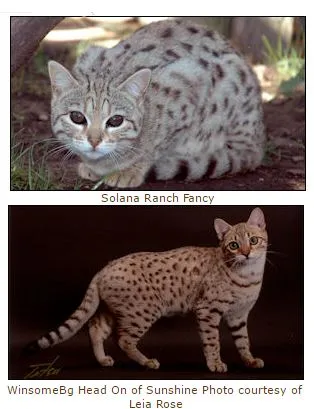
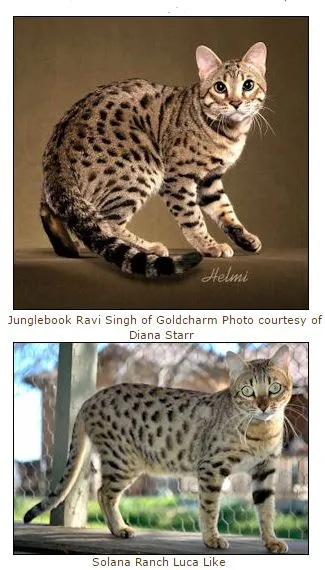
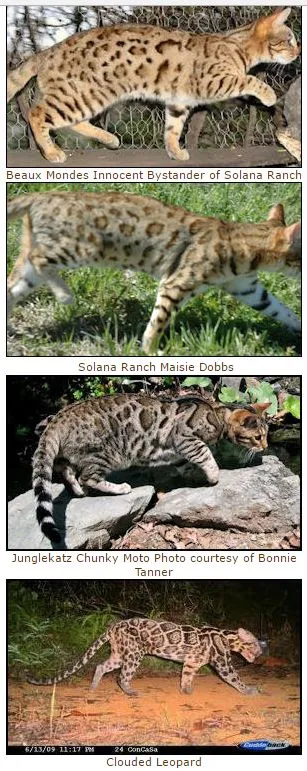
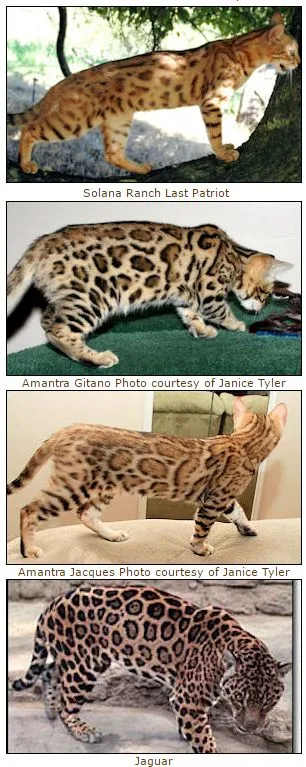
While there are many different types of leopard cats and their coats and patterns vary, one of the most visually striking patterns of the leopard cat is the arrowhead rosetted pattern. It is long sought after by Bengal breeders for its very fluid horizontal appearance. Notice how the arrowhead-shaped spots make the cat appear to be in motion even when it is standing still.
The purpose of the a rosetted pattern is for the wildcat to be camouflage in a dense vegetative habitat, and the fluidity of it suggests the leopard cat’s need to remain hidden while on the move in the dappled light of the trees in the rainforest.
The arrowhead rosette is, perhaps, the easiest type of rosette to identify for it is clearly in the shape of an arrow with all tips pointing to the back of the cat. It is arguable the most correct pattern according to the Bengal standard which calls for the spots to be horizontally aligned which happens with relative consistency on arrowhead rosetted cats.
Clouded Leopard Rosetting
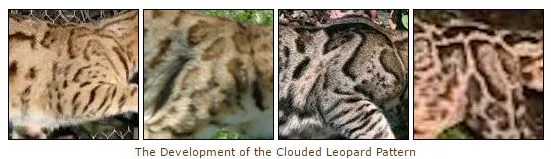
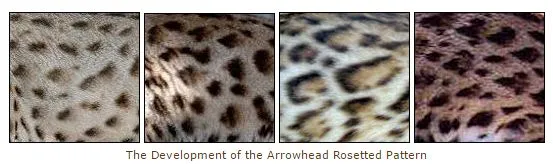
Bengal breeders have taken on the challenge of offering different looks for different people. One of the rosetting patterns Bengal breeders are trying to emulate is the Clouded Leopard. The reticulated spotting of these cats makes them look as if they have walked through a snake skin and emerged with its pattern on their pelt. The Bengals that have this pattern are particularly striking because the rosetting starts way up at their shoulders and continues to their tail.
Above you can see an enlargement of each cat’s shoulder to get a good look at what to look for in the development of the Clouded Leopard pattern on the Bengal cat. To the left, you can see the corresponding Bengal cat that goes with shoulder, ending with a picture of the model – an actual Clouded Leopard.
First, a breeder must have the vision to see that the shaded markings on Innocent Bystander’s coat has the potential to end up in a Clouded Leopard pattern. Then it takes generations of selecting offspring to develop that particular trait to end up with a Bengal cat that, like Junglekatz Chunky Moto, so closely replicates the real pattern found on a cat in the wild.
Paw Print Rosetting
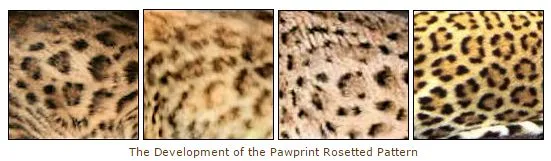
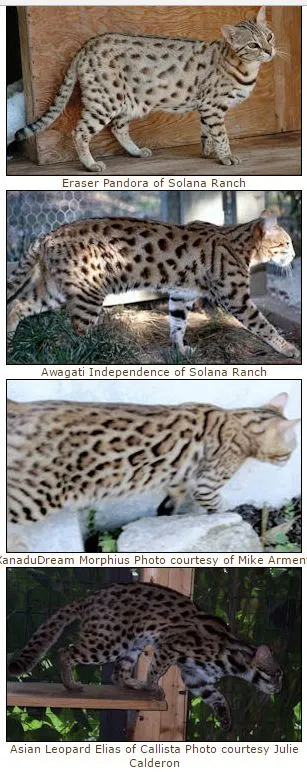
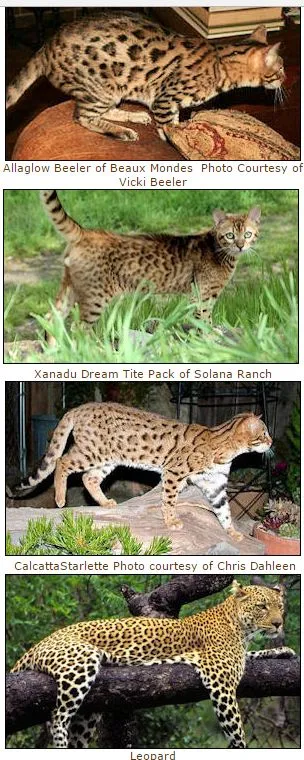
One of Jean Mill’s original goals of creating the Bengal breed was to offer people a safe alternative to owning wild animals as a pet. She wanted to create a cat that had the coat of the Leopard but the personality of a tabby cat. Therefore, Bengal breeders take on the challenge of transforming smaller leopard cat rosettes into larger, leopard-like paw print rosettes. Paw print rosettes earned their name as they often look like the shape of a paw with the center, or pad of the paw, being one color and the outside toes being a darker color. Though, not all of these rosettes are in the shape of a paw. Like the leopard’s spots, a paw print rosette is never entirely enclosed by the darker color. What seems to distinguish a paw print rosette from a donut rosette, is not so much in the spot itself but in the space between them – otherwise known as acreage. Cats whose rosettes are tightly compacted are often referred to as paw print rosettes.
Clouded Leopard Rosetting
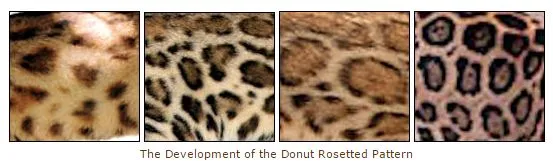
If you take a paw print rosette, enlarge it, add a little more outlining, so there is more than just “toes” of the darkest color in the spot, then add extra space between the spots, you have a donut rosette. Sounds simple, huh? Not so. This highly sought after rosette, inspired by the Jaguar as it has larger, fewer spots than the Leopard, took years of selective breeding to achieve. This rosette got its name from it’s nearly complete dark outline around a lighter central spot.
It amazing to realize the progress the Bengal cat has made with rosetting in just a few decades. The Bengal is the only domestic cat with rosetted spots which it inherited from its leopard ancestors.
Looking at the Bengal cats today, one can see the fulfillment of Jean Mill’s original intent. The Bengal cat does give people a domestic pet that looks like a wildcat to snuggle with on the living room couch. Certainly anyone who owns and loves Bengals couldn’t imagine wearing the pelt of or carrying a purse made of a real leopard, jaguar, clouded leopard or leopard cat.
It’s Not all about the Spot
With all these gorgeous rosettes why do we still have single spotted Bengal cats?
Breeding Bengal cats is a fascinating attempt to uncover nature’s secrets. How does mother nature create those perfect rosettes? We haven’t figured out how to duplicate her work in all elements of the Bengal cat. According to the Bengal Cat Standard, breeders have an overall goal of creating a “domestic cat which has physical features distinctive to the small forest-dwelling wildcats.” Physical features extend way beyond the spot. While some breeding programs focus on perfecting those spots, other breeding programs focus on perfecting the eyes, ears, skull, and body under those spots.
The single spotted Bengal plays an integral role in the Bengal breeding community as they are often exemplary examples of the structural features we are attempting to emulate. It is a challenge to get both the structural features of small forest-dwelling wildcats and the gorgeous rosettes that resemble the larger wildcat patterns on the same Bengal cat. Therefore, we need to continue to breed cats that exhibit the best of the best in both coat and structure.
Pattern, the way in which the markings on the cat are organized, is a large part of Bengal coat. Most single spotted cats have amazing horizontal flow. When they are born, the spots look like rays of sunshine jetting off the shoulders and reaching down to the tail. Frequently these cats have no connecting stripes around their legs, and often their lower legs are spotted – all of which are desirable elements of a Bengal’s pattern.
For more information on what Bengal breeders are trying to achieve structurally, please read the article on Bengal Cat Type.