What Makes a Responsible Bengal Breeder?

by Robyn Paterson
From the outside, it looks simple, but breeding cats is complex.  Unfortunately, the idea of breeding cats – a household pet, not a livestock animal – has a broad spectrum of motivations behind it.  Some people do it for the sake of making money, others because kittens are adorable, and others because they love cats. When searching for a pedigreed pet, you must unearth a breeder’s purpose for breeding.  Know their WHY.  Why do they breed cats?  Why do they breed Bengals, specifically?  A breeder’s why should come from passion, not profit, and here is how to tell the difference. 

First, it is essential to understand that a pedigree is not enough. In and of themselves, pedigrees do not guarantee anything about the quality of the cat or the breeder.  While people should never buy a Bengal without registration papers, having them does not make the breeder a good breeder or the cat a good cat. 

A responsible Bengal breeder is a steward for the Bengal breed.  This means that the breeder prioritizes what is best for the cat and what is best for the Bengal breed above what is best for themselves. A breeder should make educated decisions to place the right cat in the right home; a breeder should make various choices to improve health. A breeder should do this while also improving or maintaining the structure and beauty of the breed. But what exactly does it look like when a breeder does these three things? 

Responsible Breeders Work Hard to Place the Right Bengal Cat in the Right Home 
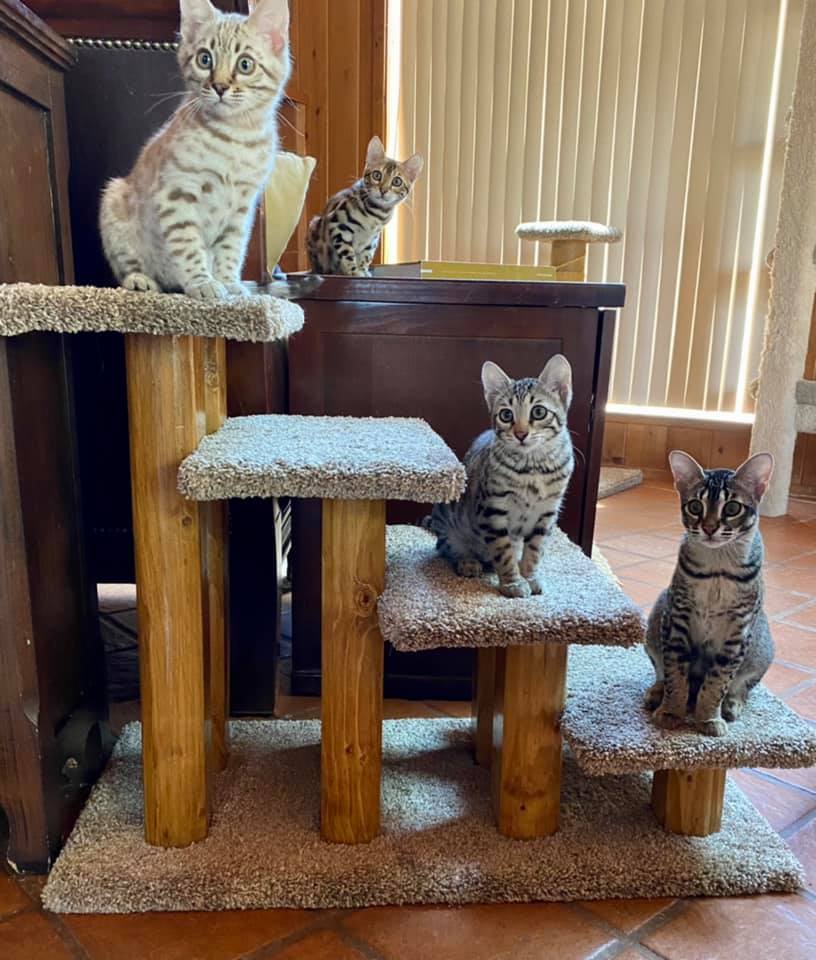
Placing the right Bengal cat in the right home is the most significant responsibility of a breeder. The Bengal cat is known for its confident, friendly, outgoing personality with high energy and intelligence levels.  This is the disposition Bengal breeders should be striving for in their cats.  If a Bengal breeder discovers a cat in their program that consistently produces temperaments that are shy, less intelligent, or low in energy, those cats should be removed from the program because they do not meet the breed goal.

Temperament is the number one controllable factor that determines the longevity of its home.  A cat with a less-than-ideal temperament is more likely to be rehomed than one with a good temperament.  If you are looking for a Bengal cat, ask the breeder how they make breeding choices that affect temperament.  Listen to the answer.  The breeder may go off-topic by talking about socialization.  If they do, bring the conversation back to breed selection by asking for an example of a breeding choice that has been made based on temperament. 

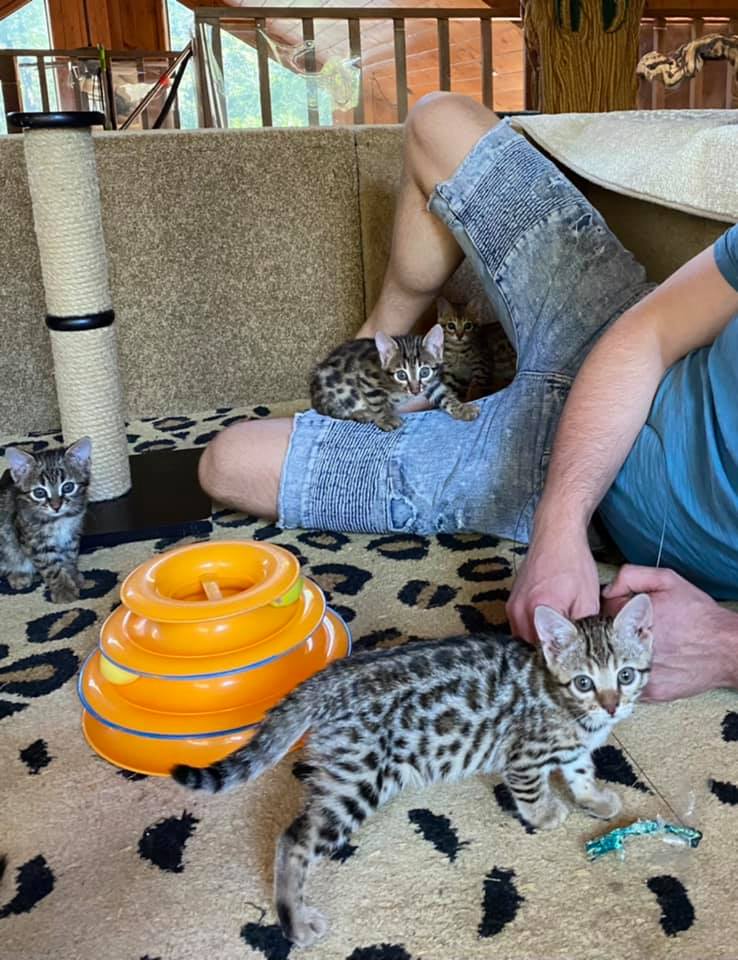
Socialization, however, is a contributing factor that affects temperament. When looking for a well-bred cat, ask what the socialization process is. Part of kitten socialization is learning to live “underfoot”  in a home.  Does this happen at your breeder’s house?  Make sure the kittens will be exposed to stimuli that they will be exposed to in your home.  For example, if you have a dog, buy from a breeder who has dogs.  But just having dogs isn’t enough.  The breeder should provide examples of knowing which kittens will adjust to dogs well.  Not every cat is the same.  We have dogs, and we know which of our kittens will, based on their genetics, be more likely to integrate easily into a home with dogs and which kittens are not expected to make good dog companions.  They won’t be bothered by or bother a dog, but they won’t befriend it either.

When looking for a well-bred kitten, be specific about what you want in a kitten, and then ask the breeder how they know the kitten will be what you want.  Good breeders know, so ask! 

Placing the right cat in the right home is not only about the cat; it is also about the home.  Not every home is the right home for a Bengal.  A responsible breeder should ask questions that reveal whether or not a home is not the right environment for a Bengal.  With Bengals being high energy and intelligent, this puts more responsibility on the owner.  A responsible Bengal breeder will ask questions to determine how a Bengal’s mental and physical needs will be met throughout its life.  Part of this is measuring the longevity of enthusiasm.  Taking a cat hiking sounds fun, but the harness training to get to that point will require repetition at a less thrilling level than camping in the Sierras with a cat. So, how realistic is the buyer’s plan for mental and physical stimulation? A responsible breeder will never talk a buyer into owning a Bengal.  They will sometimes talk a buyer out of owning a Bengal. 

Owning Bengals is more demanding than the average cat due to their energy level and intelligence.  Bengals are sensitive beings. Some struggle with change more than others. Does your Bengal breeder know which kittens will struggle with the transition?  Do they know who will take to harness training and who will be less inclined?  But in addition, does the breeder feel you out to determine how you will problem solve?  Most inappropriate behaviors that Bengals engage in stem from boredom or insecurity. The responsible breeder will only sell to buyers who will participate in problem-solving rather than solving the problem through rehoming. 

Responsible Breeders Make a Variety of Choices that Improve the Health of the Cat 
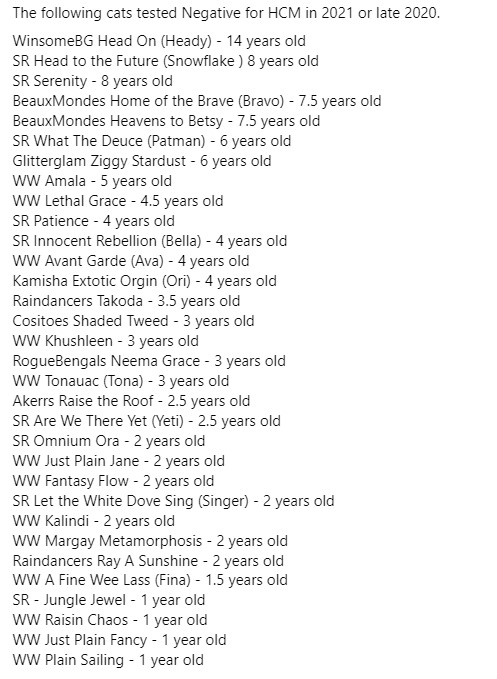
One of the benefits of buying a purebred cat should be a known health history and health testing completed on the parents of the Bengal kitten.  Responsible breeders should strive to produce cats with a longer lifespan than cats with unknown health statuses. Many factors contribute to the improvement of the overall health of the Bengal breed: health testing, health education, genetic diversity, and the health of the breeding environment. 

Health testing is every breeder’s step to improve the breed’s health.  While most buyers know about FeLV and FIV tests and testing for worms and parasites, this should not be the primary focus.  Each breed has its predisposed health concerns.  Breeds are developed by selecting genes to create a homogenous look.  When we choose desirable genes, undesirable genes come along unintentionally.  As they are discovered, breeders must weed them out.  Bengals should all be genetically tested for PRAb and PK-Def.  These are simple genetic tests; there is no excuse not to do them.  In addition, Bengals should also be scanned by a cardiologist each 12-18 months to determine heart health.  While the scan primarily searches for signs of HCM, the scan can reveal other potential heart problems. Because HCM is not a genetic test, the heart should be scanned multiple times over a cat’s lifespan to watch for changes in the heart.  A responsible breeder will know the risk level of HCM developing in their lines, and they should be willing to talk to you about it.  Ask a breeder how many cats in the kitten’s pedigree have been scanned for HCM. Ask what ages the cats were scanned to.  In addition, Polyneuropathy is a growing concern in the Bengal breed.  Don’t be afraid to ask breeders if they have experienced polyneuropathy in their breeding program and what they know about their cat’s lines regarding the likelihood of polyneuropathy. 

When asking questions about health, do NOT have a preconceived answer you want to hear.  You are listening to see that the breeder has knowledge of the health history of their cats.  Do not expect the health history to be perfect; expect the breeder to clearly understand their cat’s health history and have a rationale for their choices. 
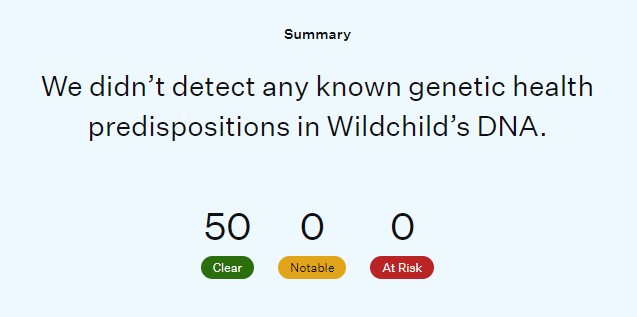
Listening to the rationale of a breeder’s choices tells you about their willingness to self-educate. Health information changes fast.  Researchers are discovering new information all the time.  When you read what a breeder puts on their website or have a conversation with the breeder, do they sound like a person interested in learning the latest advancements in health?  Can they advise you on vaccines with science-based reasoning for their choice?  A responsible breeder is your cat consultant for the lifespan of the cat.  Unfortunately, the veterinary industry grows increasingly more commercialized each year. Is your breeder capable of guiding you through making decisions regarding your cat’s health if you feel you are possibly being sold services that you may not need? Part of buying a pedigree cat should be the lifelong resource of the breeder.  This is where the “you get what you pay for” phrase should apply.  Purchase from a breeder that can be your cat consultant for your cat’s lifetime. 
Does the breeder understand how food choices affect health? Can the breeder explain the nutritional needs of an obligate carnivore that evolved from a desert animal? Evolution suggests that a raw diet with few to no plant-based ingredients heavy in moisture provides the most bioavailable nutrients to a cat. If the breeder-selected diet diverges from this, can the breeder tell you why they feed what they do based on how their food choice meets the needs of their cats? Again, hearing a science-based rationale is better than having one preconceived answer. Knowing food choices are made for reasons other than the food company giving the breeders a kickback. 

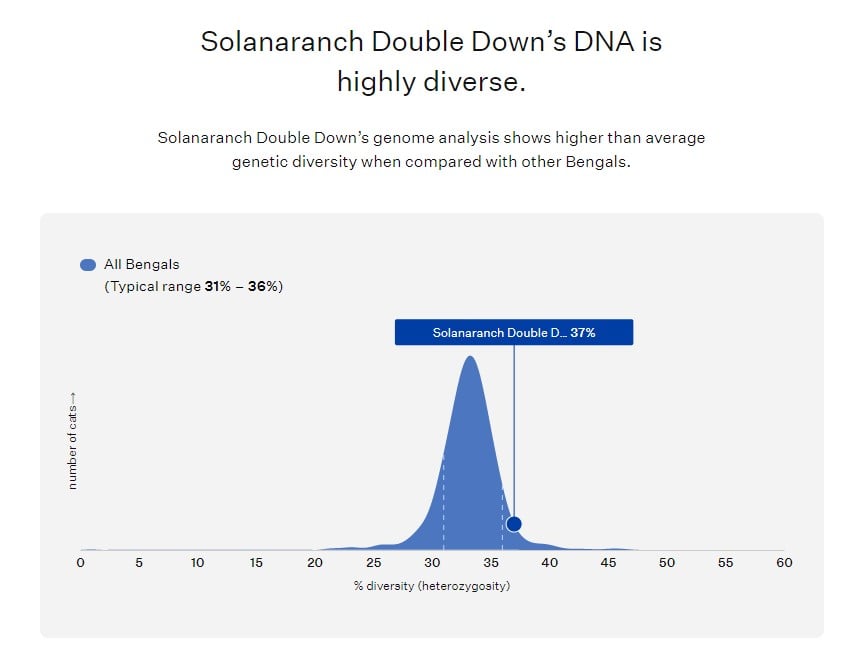
One of the biggest challenges breeders face regarding health is genetic diversity.  Genetic diversity has a substantial impact on health.  Breeds of animals are less genetically diverse because as we select for physical traits specific to a breed, we inadvertently reduce the genetic diversity. Breeders should be making decisions about genetic diversity either through DNA testing for genetic diversity or through knowledge of their pedigrees and how the cats are related beyond the standard five-generation pedigree.  Genetic testing for genetic diversity is a relatively new tool, so every breeder won’t utilize it, yet.  This does not make a breeder irresponsible if they make decisions using pedigree knowledge. 

Linebreeding in and of itself also does not make a breeder irresponsible.  But if a breeder has linebred, ask the breeder why they did the linebreed and why they were comfortable linebreeding on that particular cat.  The breeder should have an answer that includes the goal they were hoping to achieve and the known health history of the cat that was linebred upon. Typically, when linebreeding on a particular cat, that cat should be older, so the breeder knows if any heart issues developed over time, if the cat had any structural weaknesses, and if the cat produced other health ailments.  When asking questions about linebreeding, listen to see that the breeder clearly understands the breeding’s benefits and risks.  

In general, look to understand that your breeder understands that genetic diversity is a factor in producing healthy kittens.  Responsible breeders should explain their plan for maintaining, or preferably, increasing genetic diversity in their breeding program. 

Finally, a breeder will have more cats than the average person.  How do they house these cats, and how do they reduce the stress levels of their cats?  Cats become stressed in high-density populations.  Stress negatively impacts health. Again, ask the breeder how they house their cats, but do not have a specific answer you want to hear.  You should listen to the WHY of their choices.  

Responsible Breeders Breed for Correct Breed Structure and Appearance 
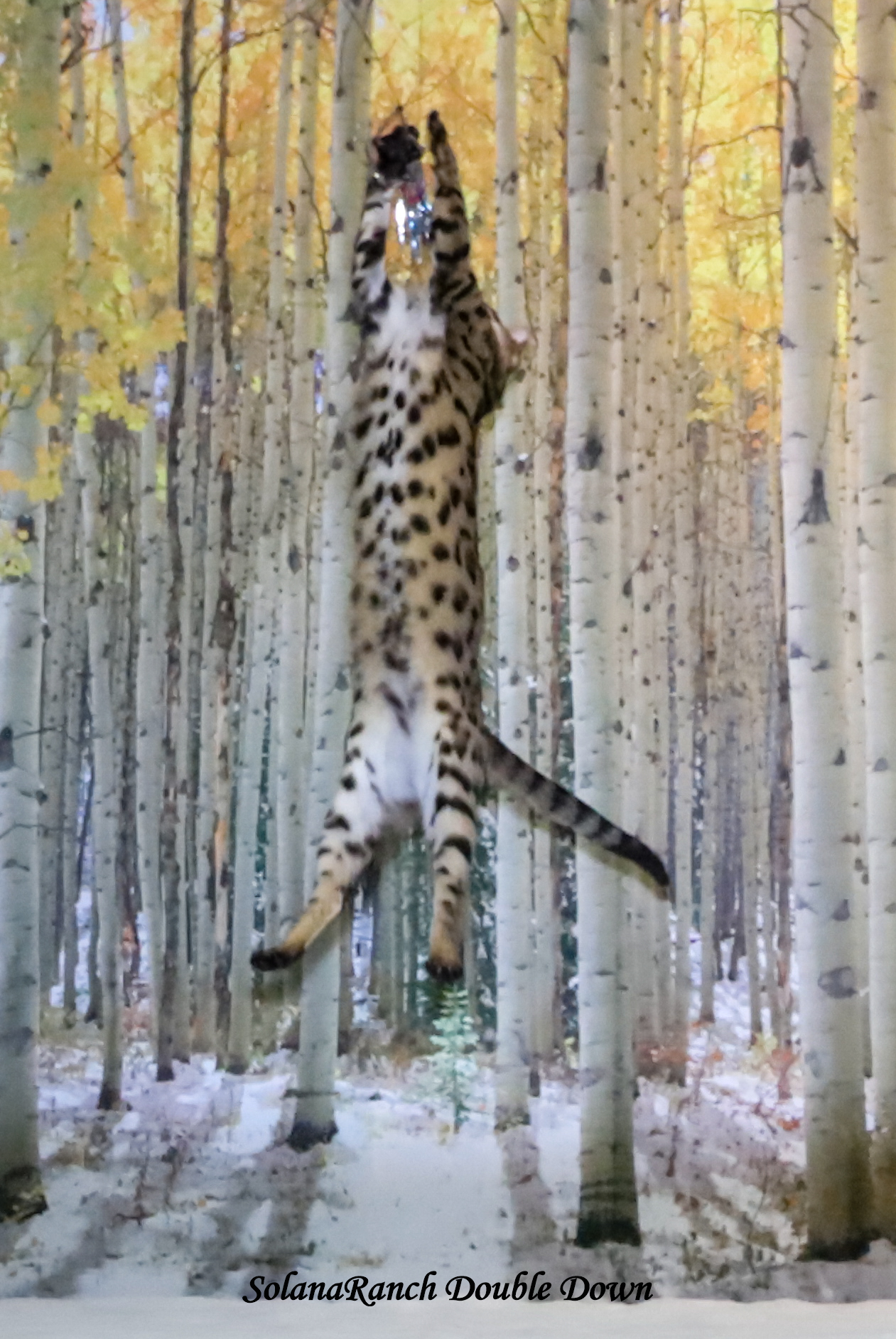
The first draw to a pedigree cat is its appearance.  However, appearance should never overshadow health; it is synergistic with health. 

The goal of Bengal breeding programs is to breed a cat that looks like a small forest-dwelling wildcat. Because of this goal, we are not breeding for any structural defects that people may find attractive. Our visual breed goal is a cat that lives in a tree – a structurally correct cat can survive in that habitat. 

A breeder should focus on the cat’s structural build. Bengals are high-energy animals who need good structure to move pain-free throughout their lives. As the Bengal ages, it should not slow down much. It should still enjoy chasing toys and running the wheel as much at year 17 as it did at month 17. 

Like in areas of health and socialization, a breeder should be able to speak to their structural goals beyond the canned answer of “I am breeding to the standard.”  Ask a breed what they are working to improve in their cats.  If they have been breeding for five or more years, ask what goals have been achieved.  Most importantly, look at how their cats move.  Are all four legs straight – not towing in or out?  You would not buy a jumping horse that doesn’t have straight legs.  You should not buy a high-energy cat that doesn’t have straight legs, as this will lead to early-onset joint pain.

The nice thing about appearance goals is that you can see them.  With the Bengal, you must look beyond the rosettes and consider how the cat is built.  Too many people, breeders, and buyers, only look at the markings of a Bengal cat. While markings may be the initial draw, you have to look beyond that when you purchase.  Ask the breeder how they assess the structure of kittens.  Have them show you.  You don’t want to be a buyer or work with a breeder who only pays attention to the paint. 

The Three Goals of Responsible breeders – Health, Temperament, and Appearance 

It all boils down to this: Responsible breeders should explain how they are bringing better cats into this world regarding health, temperament, and appearance. 

The Bengal breed is in some way disadvantaged by its beautiful coat.  For many breeders and many buyers, that is the only focus.  The coat is one-half of one-third of the equation. Don’t buy a pedigreed pet without getting the health and temperament advantages that it should come with.  When looking for the breeder of your next Bengal, make sure you find one who sees more to breeding than a cat’s coat. 


Are you thinking of getting a Bengal cat and want it to come with a lifetime of expert advice? Check out our available Bengal kittens.  

Backcrossing, Hybridizing, and the Bengal Cat

The Bengal cat falls into a category of cat breeds known as hybrids, but this label is not scientifically accurate. The confusion this creates can be problematic for the so-called hybrid breeds. Breeds labeled hybrids are, essentially, backcrossed breeds. What is backcrossing? How is it different from hybridizing? Why is the difference significant for the Bengal cat?

Hybridizing versus Backcrossing – What is the difference?

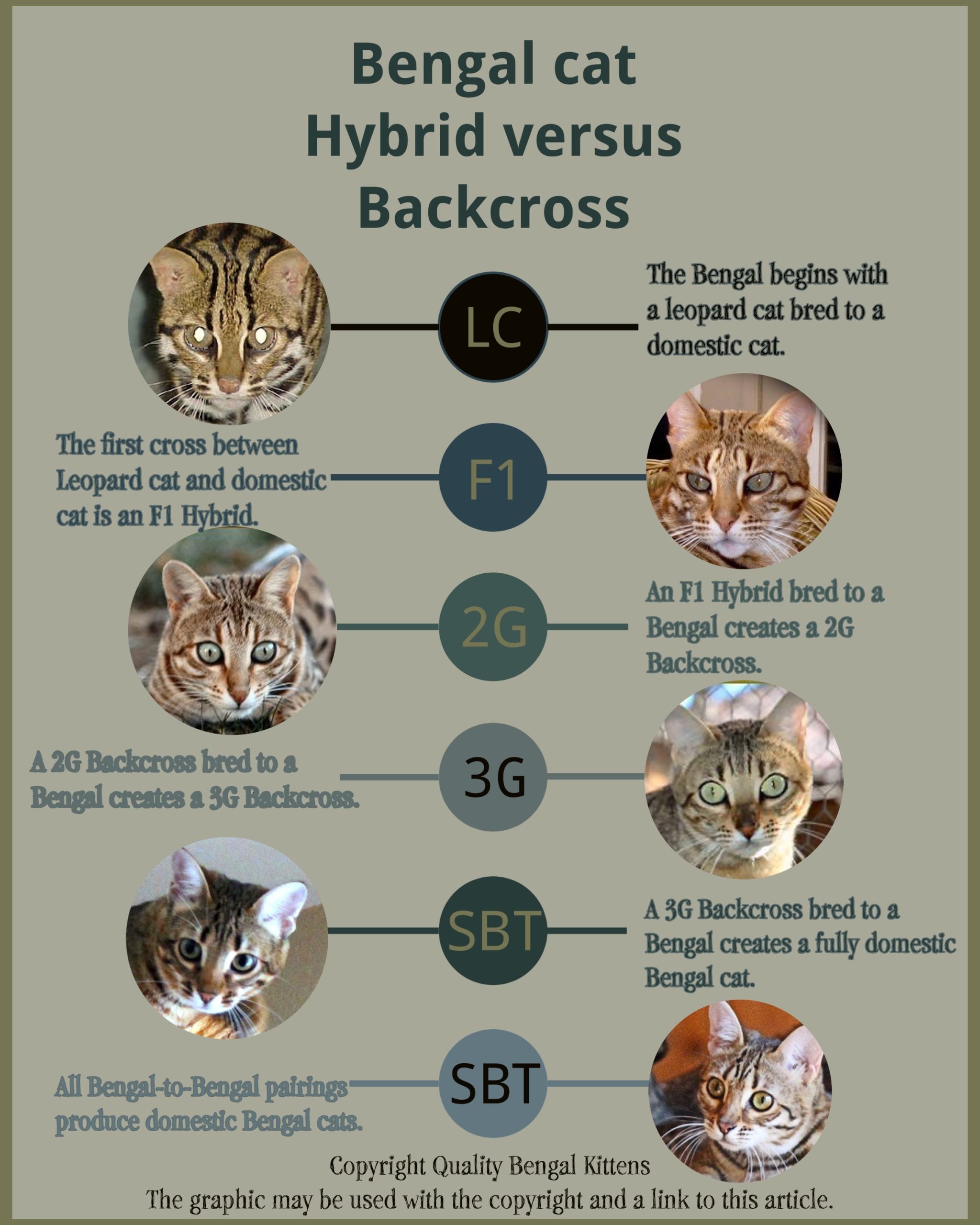
Hybridizing is when two different types of animals (species or breeds) are bred together. Hybridizing aims to combine the desirable characteristics of both types into a single offspring. The F1 Bengal is a hybrid; one parent is a leopard cat, and one parent is a domestic cat – often, but not always – a Bengal. To continue a line of hybrids, both genders must be fertile. F2 hybrids come from two F1 hybrids breeding together. This is not possible with the F1 Bengal hybrids.

The male F1 hybrid between a leopard cat and a domestic cat is not fertile. Therefore, two F1 Bengals cannot be hybridized to make F2s. Thus, F2 and F3 Bengals cannot be created. Backcrossed Bengal males remain sterile until the fourth generation. Even then, fertility can be unreliable at the fourth and fifth generations when too much leopard cat DNA has passed down.  Therefore, female F1 Bengal hybrids are backcrossed to fertile domestic Bengal males. 

Backcrossing is when an individual from a hybrid population is bred back to one of the original parent types (species or breed). Backcrossing aims to transfer specific traits from the leopard cat to the Bengal population while retaining the desirable characteristics of the Bengal cat.  The first cross between a leopard cat and a Bengal is a hybrid; however, every generation after that is a backcross.  

F1 females are backcrossed to a domestic Bengal cat to create the second generation.  This generation is scientifically called N1 or BC1.  However, this terminology can cause confusion within the Bengal breeding world because N1 or BC1 could easily be confused with F1 creating a misunderstanding of how many generations the cat is removed from the wild species.  To keep the generations from the wild species clear, Bengal breeders started using G as an abbreviation for generation. Instead of calling the second generation an N1 or BC1, we call them a 2G for second-generation backcross. 3G stands for the third-generation backcross.  At four generations away from the leopard cat, over 50% of both genders are fertile.  This is considered the true start of the Stud Book Traditional (SBT) Bengal breed.  

The distinction between hybridizing and backcrossing is important for the Bengal cat. When hybridizing, one is maintaining equal parts of both species. When backcrossing, the leopard cat genetics reduce, and the domestic Bengal cat genetics increase with every generation. The goal of the Bengal breed is to create a domestic cat with the appearance of the leopard cat, but the personality of the domestic cat.  

How much leopard cat DNA does a Bengal have?

Through Chris Kaelin’s recently released research study, we have learned more about the limited number of genes that the leopard cat passes down to the Bengal. The leopard cat’s genes are not evenly spread through Bengal DNA. Furthermore, they had passed down at a lower rate than expected, suggesting that there may have been times when only certain types of leopard cat genes were selected to be passed down. Researchers studied the genes of 722 Bengal cats and found that only a few of their genetic regions showed signs of leopard cat DNA. Problems with incompatible genes appear to have limited how much leopard cat ancestry Bengal cats have.

It isn’t easy to bring a new leopard cat line down to SBT Bengal. For example, we have one 2G female who did not produce her first litter until she was seven years old. Not every breeder has the patience to work with cats who do not breed quickly; thus, some hybrids never contribute to Bengal cat genetics. This creates a situation where only some leopard cats’ genes get passed on, leading to some genetic bottlenecks. 

After the F1 generation, some leopard cat genes simply do not pass down. In the study of 722 SBT cats, researchers learned  7% of the Bengal cat genome does not have any leopard cat genes in any of the SBT Bengals. The leopard cat DNA ranged from .4% to 16% in SBT Bengals. The average Bengal cat has less than 3% leopard cat DNA.

Why is all of this important?

As regulations on wildcats spread worldwide, the Bengal cat must be recognized for what it is – a domestic cat. At times the Bengal cat is misrepresented as the genetic equivalent of a liger or coydog because they are called a hybrid breed. Bengals are NOT a hybrid breed. The breed begins with an F1 Hybrid, but after three successive generations of backcrossing to domestic Bengals cats, the offspring are genetically domestic cats. It is important that breeders, owners, and legislators all recognize the Bengal as the domestic cat that it is.

Work Cited

Kaelin, Christopher  B., et al. “Ancestry dynamics and trait selection in a designer cat breed.” bioRxiv, Cold Spring Harbor Laboratory, 12 December 2022, https://www.biorxiv.org/content/10.1101/2022.12.12.520105v1.full.pdf. Accessed 12 February 2023.


Are you thinking of getting a Bengal cat and want it to come with a lifetime of expert advice? Check out our available Bengal kittens.  
Bengal Breeders: Know the Facts About How Mislabeling Affects Shelter Statistics

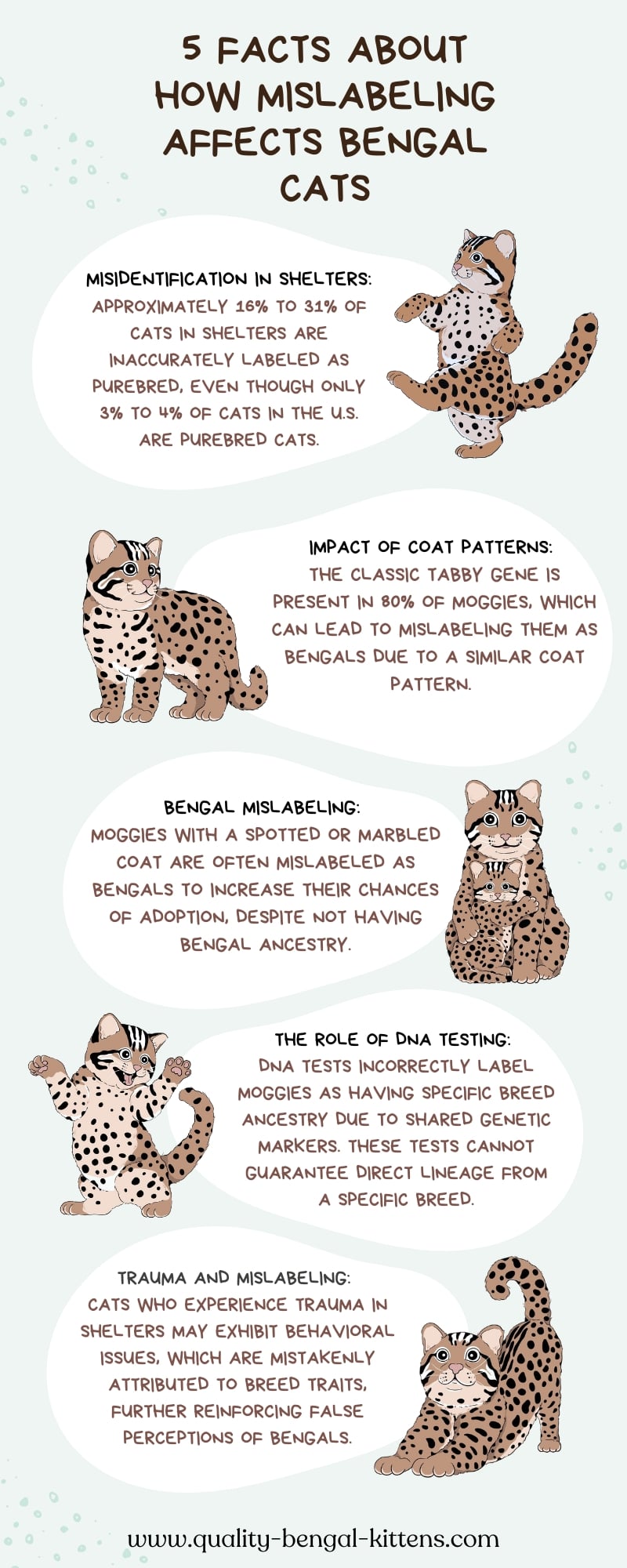
Regarding Bengals, there’s a persistent and misguided belief circulating that Bengals frequently end up in shelters due to behavioral issues, making them poor pets. This assumption, however, is based on a series of misunderstandings. One of the most significant contributors to this misconception is the frequent misidentification of cats in shelters. As a result, statistics about purebred cats, including Bengals, are often wildly inaccurate, leading to the false perception that Bengals are commonly abandoned. Misidentification, along with flawed DNA testing, has distorted the reality of how many Bengals truly end up in shelters. This misconception needs to be addressed so Bengal breeders are armed with facts.

Misidentification of Pedigree Cats in Shelters

To address this misconception, it’s essential to first understand the actual proportion of cats purchased from breeders. In the United States, only 3% to 4% of cats are purchased from breeders, according to both the American Pet Products Association and the AVMA. Globally, this percentage is only slightly higher, hovering between 3% and 6% (“Pets by the Numbers”). Despite the small proportion of cats that are purebred, shelters often report a high percentage of “purebred” cats. So, how do these numbers make sense? The explanation lies in how shelters identify cats, where misidentification plays a considerable role.

One of the most significant issues is that 16% to 31% of cats in shelters are labeled as purebred (“Pets by the Numbers.”). This is an obvious discrepancy when compared to the small percentage of breeder-purchased cats. As Smithsonian Magazine points out and The Humane Society confirms, shelters frequently misidentify the breed of cats and dogs based on appearance alone, significantly overestimating how many purebred animals are in shelters (“Pets by the Numbers”). With Bengals being a popular breed known for their appearance, the chances of misidentification are even higher. From 1993 to 2021, Bengal cats were The International Cat Association’s most registered breed. This popularity increases the likelihood of a domestic shorthair with no pedigree cats in its genetics being mislabeled as a Bengal. 

The Bengal’s coat patterns play a significant role in why they are frequently misidentified. While Bengals are known for their coats, which can be spotted or marbled, these coat patterns aren’t exclusive to Bengals. Many domestic shorthairs or mixed-breed cats naturally develop spots. Shelters that rely on visual traits alone often categorize any cat with spots as a Bengal, even if they don’t have Bengal ancestry. This mislabeling is even more likely when it comes to the classic tabby gene, which is present in approximately 80% of mixed-breed cats (“Tabby Cat”). This gene, responsible for the circular pattern on many tabby cats, can resemble the marbled patterns of a Bengal, further complicating accurate identification. The assumption is that potential adopters are often attracted to specific breeds, especially purebreds, which are seen as more desirable. According to Fear Free Happy Homes, “shelters often attribute breed names to feline residents to make them more appealing,” resulting in a faster adoption (Bahner)​.


In addition, the Best Friends Animal Society indicates that adoption trends of younger adults favor pedigree pets ​(“2023 National Data Report”); therefore, cats labeled as pure breeds boost adoption rates due to the perceived value of purebred pets. This mislabeling practice can significantly improve a cat’s chances of finding a home, with many adopters mistakenly believing they are getting a specific breed when, in fact, the cat most likely has no pedigree cats in its lineage at all.  Unfortunately, cats with no known ties to being a Bengal other than a similar coat pattern are labeled as Bengals to get them a home faster. 

When a cat is inaccurately labeled as a Bengal, the initial misidentification can create a mismatch cycle between the cat and its adoptive family. Often, adopters take home a cat expecting breed-specific behaviors, only to be surprised when the cat’s temperament or needs differ from their expectations. For instance, a mislabeled Bengal might not display the high energy levels or playfulness that people associate with the breed. This disconnect can lead to frustration, and the cat is sometimes returned to the shelter. The problem is further compounded when the cat re-enters the system with the same inaccurate label, making the cycle more likely to repeat. Returned pets are already at a disadvantage, and the continued mislabeling can reduce their chances of finding a permanent home. Not only does mislabeling cause initial adoption issues, it can lead to repeated shelter stays, ultimately hindering the cat’s chances of finding a suitable and lasting home.

Furthermore, shelter cats may experience various forms of trauma, such as abandonment, neglect, or being shuffled between multiple homes. This trauma can manifest in behaviors like insecurity, anxiety, or even aggression. The adopter may become frustrated when the cat acts out. These behaviors, stemming from trauma, are then seen as “Bengal problems,” further cementing the misperception of the breed. When the cat is returned to the shelter, this can exacerbate the issue. Trauma-related behaviors are mistaken for breed traits on a mislabeled cat. If those mislabeled cats are repeatedly returned, it perpetuates the myth that Bengals are difficult or aggressive pets. This creates a compounding issue, where breed labels are incorrectly tied to trauma-induced behaviors, distorting the reputation of Bengals.

Breed Identification DNA Testing: A Flawed Tool

While DNA testing may seem like a good solution for accurately identifying a cat’s breed, it, too, comes with its own set of problems. DNA breed identification tests compare a cat’s DNA to a reference database of known breeds. However, these tests often produce inaccurate results because their accuracy depends on how comprehensive the reference database is. Smithsonian Magazine explains, “the reference database may not cover all the possible genetic lineages” (Solly). This means that DNA tests can indicate that a cat belongs to a particular breed even if it has no direct lineage to that breed. For instance, a moggies cat may share some genetic markers with a Bengal, but that doesn’t necessarily mean it has Bengal ancestry. 

DNA tests were initially developed for use with pedigree animals, which have well-documented lineages. However, most cats worldwide are “moggies”—naturally occurring mixed-ancestry cats with no specific breeds in them. Unlike dogs, where mixed breeds sometimes have pedigree breeds in their background, most moggies don’t come from recognized breed lines. As Cats Protection explains, pedigree cats are rare, and most cats don’t belong to a lineage that would be recognized by breed registries (“Getting a Pedigree Cat”). DNA tests identify breed markers, but that does not mean that moggies have a cat with that breed in their ancestry. Many breeds of cats share similar genetic markers due to common ancestors or traits not exclusive to one breed. For example, coat colors or patterns, like tabby markings, are present in multiple breeds and moggies. 

Pedigree cats – all of which originated from moggies – share genetic markers with modern moggies due to common ancestry before the creation of pedigree cats.  Modern breeds have existed for less than 150 years (“Domestication of the Cat”).  Domesticated cats, in general, have less genetic variation compared to dogs. As a result, moggies may show genetic similarities to multiple breeds, even if they don’t have a direct lineage from those breeds. If a test finds that a moggie has markers resembling a certain breed, the DNA test will report a “match,” even if that breed is not part of the cat’s actual lineage. The test essentially finds similarities in the genetic code, which can happen by chance or due to distant genetic overlap. So, a DNA test might pick up a marker associated with a particular breed, but this does not guarantee that the cat has a purebred ancestor from that breed. For the millions of moggies, these DNA tests produce misleading results that imply a moggie is created from pedigree cats when it is not.  Pedigree cats were created from moggies, and the ancestry is so close that the DNA markers are shared.

While some Bengals do end up in shelters, they are not disproportionately represented compared to other breeds. The perception that Bengals are overrepresented in shelters due to behavioral issues is not grounded in accurate data. Mislabeling of mixed-breed cats as Bengals, along with flawed DNA breed testing, has inflated the number of supposed “Bengals” in shelters. Bengals are not inherently problematic pets—they, like all other high-energy cats, need a family that will engage with them to provide mental and physical stimulation. Bengal breeders must take the time to educate their buyers on the needs of a high-energy cat and ensure the buyer has the time and dedication to meet the cat’s needs before placing a Bengal in their home. As breed identification becomes more accurate and shelters move away from unreliable visual assessments, the myth surrounding Bengals in shelters can be dispelled.

Works Consulted

“2023 National Data Report.” Best Friends Animal Society, Best Friends Network, 2023, https://network.bestfriends.org/research-data/national-dataset. Accessed 6 Oct. 2024.

“Adopter Handout: Breed Labeling.” HumanePro, Humane Society of the United States, 6 Oct. 2024, https://humanepro.org/magazine/articles/adopter-handout-breed-labeling. Accessed 6 Oct. 2024.

“The American Pet Products Association (APPA) Releases 2024 Dog and Cat Owner Insight Report.” American Pet Products Association, www.americanpetproducts.org. Accessed 6 Oct. 2024.

Bahner, Sally. “Want a Pedigree Cat? Here’s What to Know.” Fear Free Happy Homes, Fear Free, www.fearfreehappyhomes.com. Accessed 6 Oct. 2024.

“Cat Coat: Tabby and Genetics.” The Little Carnivore, 2024, www.thelittlecarnivore.com. Accessed 6 Oct. 2024.

“Cat Genetics: A Progressive Look at Coat Colors & Patterns.” Liz’s Kitty Boot Camp, Tails & Tips, 2022, www.lizskittybootcamp.com. Accessed 6 Oct. 2024.

“Decoding the Tabby Cat: Purebred or Mixed?” Cat Breeds List, 1 Feb. 2024, www.catbreedslist.com. Accessed 6 Oct. 2024.

“Domestication of the Cat.” Wikipedia, en.wikipedia.org/wiki/Domestication_of_the_cat. Accessed 6 Oct. 2024.

“Getting a Pedigree Cat.” Cats Protection, www.cats.org.uk/advice/getting-a-cat/getting-a-pedigree-cat.

“Pets by the Numbers.” Humane Society of the United States, https://humanepro.org/pets-by-the-numbers.

“Pet Statistics.” American Society for the Prevention of Cruelty to Animals, www.aspca.org/animal-homelessness/shelter-intake-and-surrender/pet-statistics. Accessed 6 Oct. 2024.

Solly, Meilan. “Genetic Testing Shows Animal Shelters Often Misidentify Dogs’ Breeds.” Smithsonian Magazine, August 27, 2018, www.smithsonianmag.com.

“The State of U.S. Animal Sheltering, 2022.” Best Friends Network, Best Friends Animal Society, network.bestfriends.org/research-data/state-us-animal-sheltering-2022. Accessed 6 Oct. 2024.

“Tabby Cat.” Wikipedia, en.wikipedia.org/wiki/Tabby_cat. Accessed 6 Oct. 2024.


The Color That Captures Our Hearts: Why We Love Brown Bengals with White Bellies

The Vision That Drew Us In

The goal of the Bengal breed has always been clear: to create a wild-looking cat with a domestic temperament. That vision resonated with both of us from the very beginning – not just because of how breathtaking these cats can be, but because it felt like a preservationist goal. Wildcats are beautiful, but they aren’t meant to live in homes. They need expansive territory and near-constant stimulation to thrive. By contrast, the Bengal gives people the beauty and awe of a wild animal in a companion that truly belongs in a home. That balance – the reverence for nature without compromising a cat’s quality of life – is something we deeply respect.

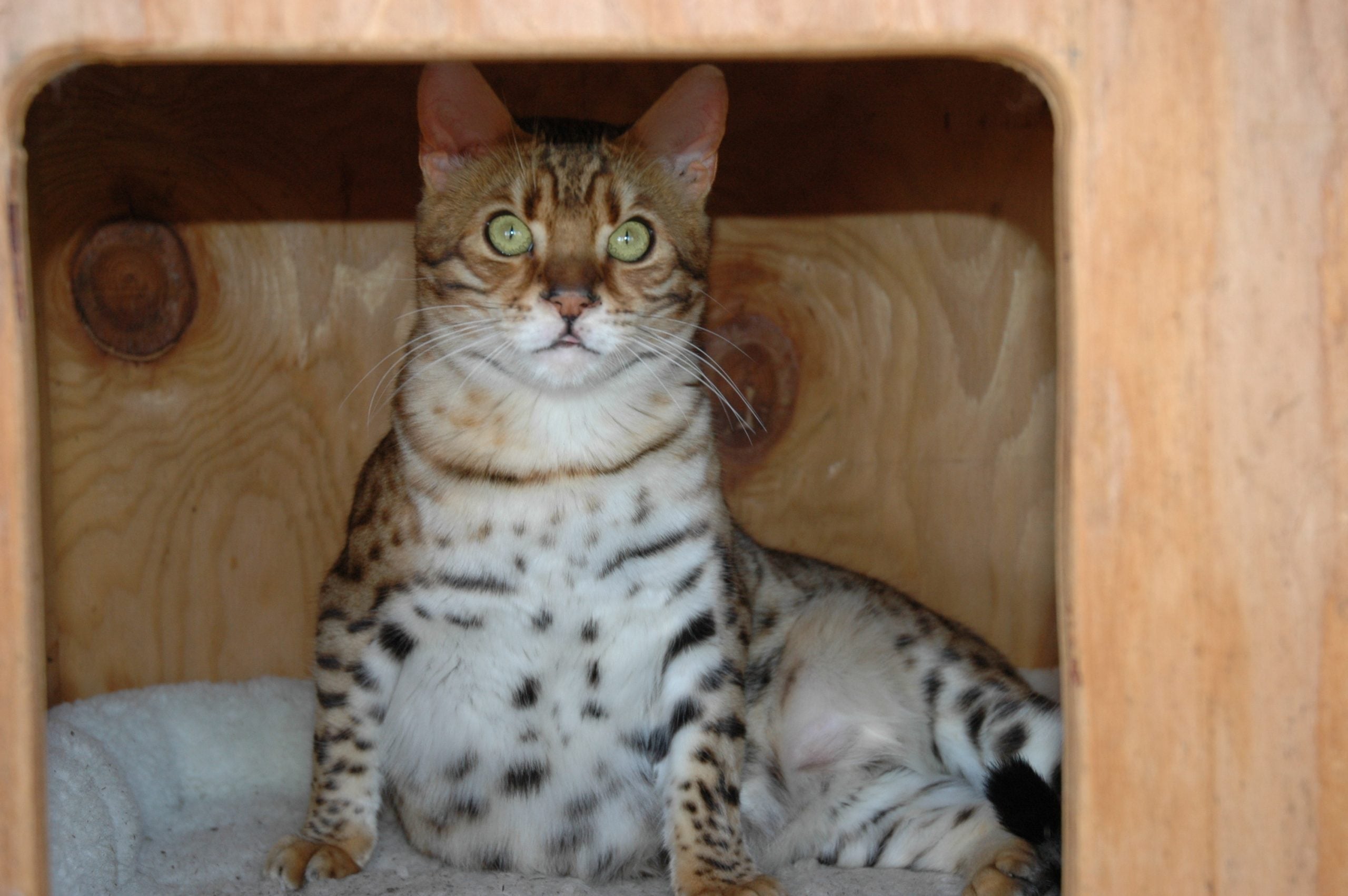
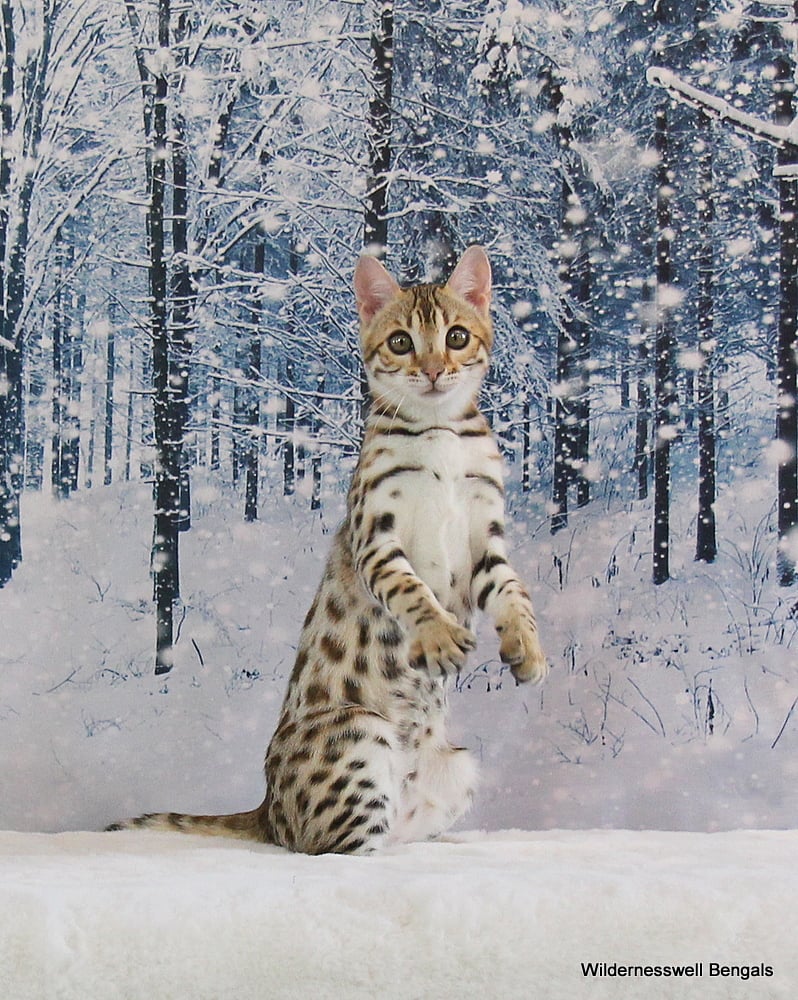
Both of us were independently drawn to brown Bengals with white bellies long before we met. There’s something about that look – warm golden tones, dramatic contrast, and the unmistakable softness of countershading – that felt like the closest thing to the cats we admired in the wild. For me, it was Rosettea’s breeding program that first brought this vision into sharp focus. Rosettea was producing white-bellied Bengals better than anyone else, and I knew I had found what I was looking for. I’ll never forget picking Rosettea Lothar – my first true countershaded Bengal – up from the airport. Seeing a true, as Lisa would say, “blue white” bellied Bengal in person was a heart-stopping moment. You don’t just see it; you feel it.  Lothar didn’t just meet my expectations; he redefined them.

To this day, producing a beautiful brown Bengal with countershading makes us feel like we’re doing what the breed was meant to do—bringing the wild beauty of the forest into people’s homes, without taking a wild animal out of it.

The Aesthetic Ideal (And the Challenge Behind It)

What Bengal breeders refer to as a white belly is actually part of a scientific concept known as countershading. This ancient camouflage pattern, dating back to some of the earliest known land vertebrates, and possibly predating those, is most commonly found in animals that are viewed from below, such as dolphins, sharks, squirrels, monkeys, and, of course, wildcats that spend their lives in trees, forests, or jungles.

Countershading is more than a cosmetic detail. It is one of the defining features of the tree-dwelling wildcats our breed was created to emulate. From clouded leopards to margays to the leopard cat, this gradient from brown and black to bright white underparts helps these wild cats blend seamlessly with their environment. On a Bengal, it brings the pattern to life in a way no solid-colored belly can. It’s not just color – it’s evolution, art, and instinct all in one.

The combination of rich, warm brown, crisp black pattern, and a true white belly is incredibly difficult to achieve. The pigments fight each other. If you push for warmth in the brown base coat, you risk losing the black outlines to chocolate or charcoal tones. If you stabilize the black and white, you often sacrifice the golden warmth of the background, leaving you with grayish or sandy tones. Achieving all three – golden brown, true black, and clean white – is like chasing a unicorn.

I’ll never forget the first time I saw a jaguar at the zoo or the striking coat of an ocelot under sunlight. The intensity of their colors was breathtaking – bold, wild, and unapologetically vivid. That level of pigment saturation and contrast has always stayed with me. It’s something we want to bring into the homes of our kitten families. We aren’t there yet – but every brown Bengal we breed with that wild level of contrast and countershading brings us one step closer.

These colors are undeniably more wild-looking. Why? Because they mimic the palette and structure of actual wildcats. No other combination of colors and pattern placement reflects nature with the same accuracy. A Bengal with a rich brown coat, bold black markings, and a white belly doesn’t look like a pet pretending to be wild. It looks like a wild animal that somehow belongs in your living room.

Why It Matters to the Breed

Jean Mill, the founder of the Bengal breed, had a vision that went beyond beauty. She wanted to create a cat so stunning that it would make people think twice before wearing real fur. Her dream was that people who shared their lives with a cat that looked like a leopard or ocelot might stop to consider the consequences of fur fashion. She believed that beauty could inspire compassion.

When we breed brown Bengals with white bellies, it feels like we are honoring her legacy. This look – the one that takes your breath away and makes your guests pause – isn’t just about aesthetics. It’s about connection: to nature, to purpose, and to a more ethical way of living with animals.

The Breeder’s Dilemma (And Why We Still Strive for It)

It’s important to say that color alone doesn’t guide our program. A cat must be healthy, well-tempered, structurally sound, and emotionally resilient. Sometimes, we move forward with cats who have less white than a parent but who represent important advances in other areas – bone structure, temperament, or type. Sometimes we hold onto a kitten because the white is everything we’ve been working toward, even if other traits aren’t as refined. Breeding is always a balance.

But make no mistake – the white belly still pulls at our hearts. It reminds us what we’re aiming for. When we see it in a young kitten, we pause. We ask if this might be the one that brings us closer to that elusive, complete picture: the cat that looks like it stepped out of the rainforest, but sleeps curled on your lap.

 Why Browns with White Bellies Will Always Be Our Favorite

There are many beautiful Bengals in all colors, but silvers, snows, charcoals, and other novel variations don’t reflect the palette of the leopard cat. They may catch the eye, but they don’t capture the heart in the same way. Brown Bengals with white bellies are different. They feel true. Familiar. Ancestral.

With so many other cat breeds already offering every color under the sun, Bengals don’t need to mirror the full domestic color palette. What makes this breed special is its preservation of the wild – the way it holds onto the essence of the leopard cat while living comfortably in our homes. 

For us, this isn’t about novelty – it’s about legacy. Brown with countershading is the look that first pulled us in, the look that still stops us in our tracks, and the look that keeps us grounded in what the Bengal breed was always meant to be. This color combination doesn’t just look wild – it is wild, in the most beautiful, thoughtful, and intentional way.

More About Us
We are dedicated Bengal breeders who focus on preserving the breed’s original purpose: to bring the beauty of the wild into our homes – ethically, responsibly, and with heart. Our program centers on producing brown Bengals with white countershading, honoring the leopard cat lineage while prioritizing health, structure, and temperament.

Want to dive deeper into what makes the white belly so special?
Read our blog post on the science and beauty of countershading in Bengals.

Cleaner Paws, Fresher Floors: Our Switch to Cat Butler Litter

For over fifteen years, Dr. Elsey’s Unscented litter has been our go-to recommendation. We try nearly every other litter that people swear by, and none of them compare. The number one factor that always rules a litter out for us is the smell. If we can smell it, it is an absolute no-go for us. Fortunately, the cats agree with us on this factor. Dr. Elsey’s has kept our house odor-free for a very long time.

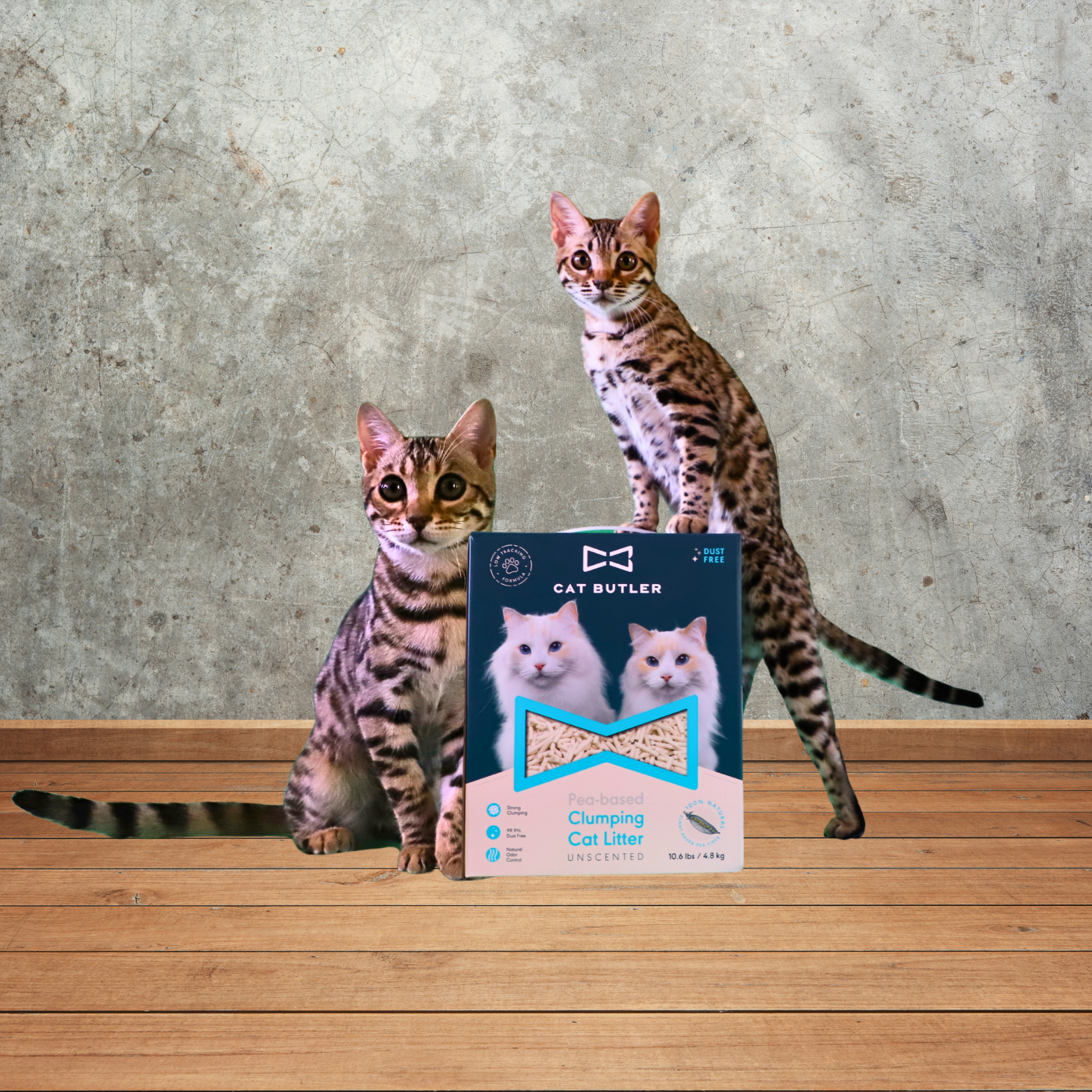
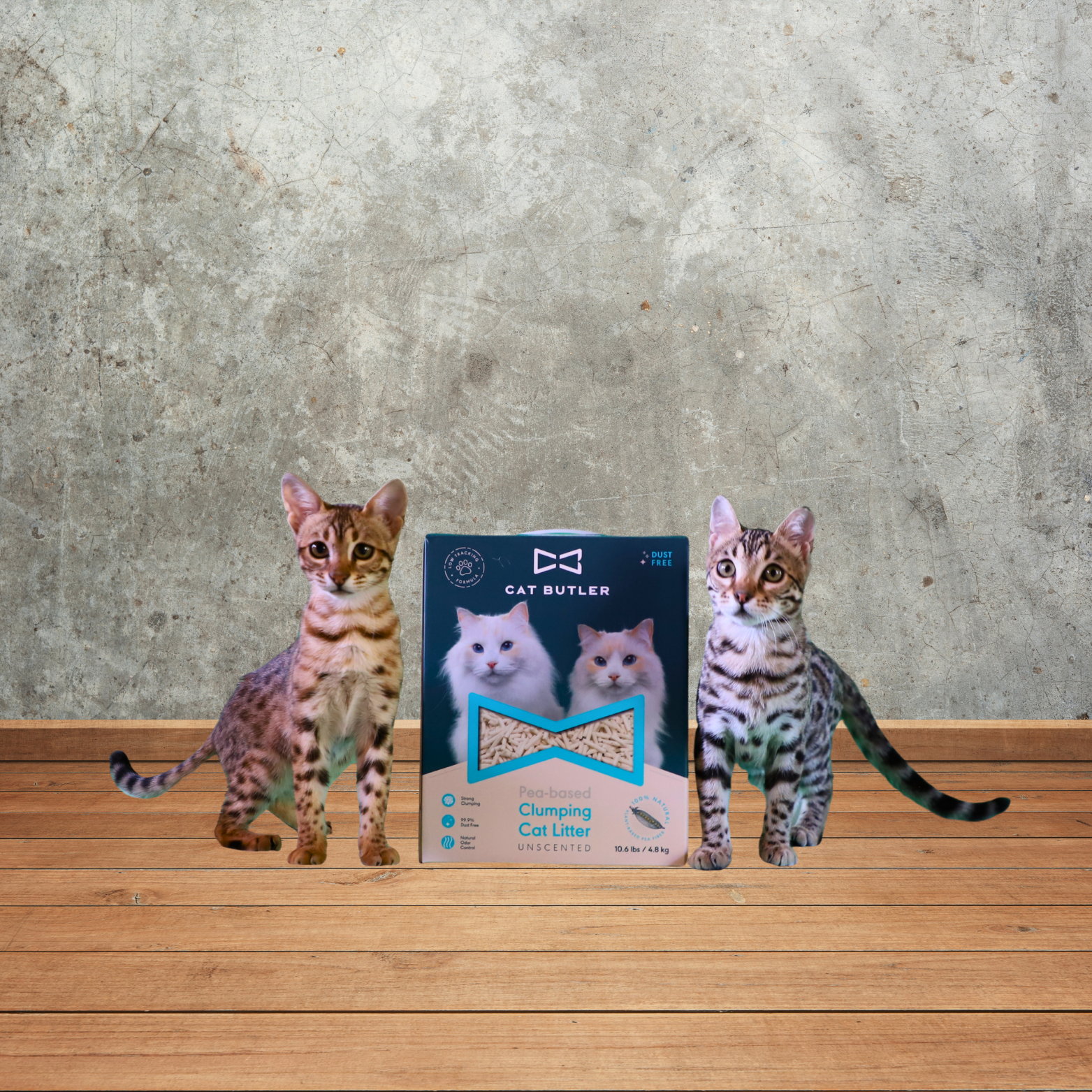
We were not looking to change, but at a recent cat show, we met the owner of Cat Butler and agreed to try his product. We were thrilled to open the bag and discover that it is, as proclaimed, odor-free. Many litters claim to be odor-free, but the reality doesn’t measure up. Not this one.

Within the first few weeks, we saw that Cat Butler offers benefits that make our lives easier and keep our cats cleaner. The first thing we noticed was the lack of residue. Bengals have a habit of playing in their water bowls and then playing in the litter box. I know, it’s disgusting, but they are Bengals. With Dr. Elsey’s, this means gray paw prints across our Saltillo tiles and residue on the cats’ coats. With Cat Butler, the pellets are shaped to resist sticking to paws, which reduces tracking and scatter, therefore leaving no marks on the floor and no residue. Furthermore, the pea fiber is also naturally dense, so it doesn’t break down into fine particles and produce the same dust you get with clay. This means cleaner paws, cleaner coats, and cleaner air. That alone is a noticeable benefit.

Scooping is also easier. With Dr. Elsey’s, if we get behind on scooping, a cement-like block forms at the bottom of the litterbox. These are especially challenging when we have a pet sitter whose scooping skills are never quite up to par with our own. With Cat Butler, the cement block does not form. The starch in the pea fiber used in Cat Butler quickly absorbs liquid. It binds it into strong, tight clumps that not only don’t break apart but also stay separate from each other, making them easier to scoop out, even when the litterbox scooping gets behind schedule. In addition, the litter is about 60% lighter than clay, which makes pouring and refilling less of a chore. These may seem like small changes, but when you are cleaning multiple litter boxes every day, they add up.

The most important test is always going to be odor. Cat Butler passes the opening of the box odor test, but does it pass the your-house-does-not-smell-like-cats test? Answer – yes, it does. The litter itself has no strong fragrance. When the cats urinate, there is a faint Play-Doh-like scent that disappears quickly. Because the pea fiber locks in moisture so fast, the box stays drier and fresher, which helps keep odor down even more. Combined with the fact that our cats are raw fed, which already reduces odor, the result is an odor-free house that visitors still comment on.

Our one hesitation in trying Cat Butler was the texture. Cats naturally prefer a sand-like litter, and Dr. Elsey’s provides that. Cat Butler is a small pellet made from pea fiber. At first, our Bengals hesitate, and we wonder if they will reject it. To give them the choice, we set out one box of Cat Butler litter next to a box of Dr. Elsey’s litter. Over time, they begin using the Cat Butler box with as much ease as the Dr. Elsey’s box, and within a month, they are choosing the pellets regularly. If we ever face litter box problems again, we will temporarily use Dr. Elsey’s Cat Attract until the issue is resolved, just as we still advise anyone struggling with litterbox issues to use Cat Attract until they are resolved. But when everything is status quo, Cat Butler is our daily litter.

Another benefit worth mentioning is what Cat Butler is made from. The litter is created from peas, specifically a byproduct of gluten-free food production. Instead of going to waste, that pea fiber is reused in a way that is safe for cats, biodegradable, and sustainable. It is food-grade material, naturally low in dust, and free from chemicals. We’ve seen the infamous Jean Mill cat litter mound visible by Google Earth’s camera, so it does make us feel better knowing we are choosing something lighter on the environment.

For us, the change is worthwhile. Our floors are cleaner, our cats are cleaner, the litter is lighter to handle, and the boxes remain odor-free. Cat Butler earns its place as our new favorite cat litter.